

A Boost for Damaged Lungs
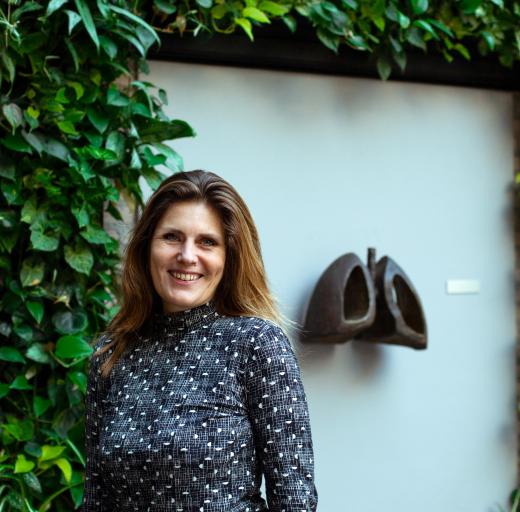
Tiny gel spheres designed to repair damaged lung tissue: Professor Irene Heijink and her team are working hard to make this a reality. They are investigating whether medicines delivered through these tiny gel spheres can repair the alveoli (air sacs) in the lungs of people with COPD.
The lungs can repair some damage on their own. But in people with COPD, this repair system does not work well enough. ‘The alveoli remain severely damaged, reducing the amount of oxygen the lungs can absorb. This causes breathlessness and fatigue,’ explains Irene Heijink, a medical biologist and researcher at the University Medical Center Groningen (UMCG). The lungs contain special cells that help repair damaged tissue. However, these stem cells do not function as well in people with COPD. They produce too few growth factors, which means that damaged alveoli are no longer repaired or replaced. Irene Heijink explains the research, which has now been completed. ‘Our aim was to reactivate these supporting stem cells, so that they would hopefully start producing growth factors again. If successful, this could also allow the alveoli to repair themselves. We wanted to find out whether existing medicines could stimulate these stem cells.'
Promising Results
The researchers tested the medicines in several ways. First, they used miniature lungs grown in laboratory dishes from cells donated by people with COPD. ‘When we added the medicines to these miniature lungs, we saw that the alveoli developed much better. That's a very encouraging start,’ says Heijink. Next, the researchers tested the medicines on pig lung tissue. Pig and sheep lungs are structurally very similar to human lungs. ‘Lung tissue has a complex structure, which allowed us to closely observe what happens when medicines are added. These results also look promising.’ Finally, the researchers used lungs that are kept breathing outside the body. ‘This is a highly innovative and valuable model,’ Heijink explains. ‘However, there is one drawback. At present, the lungs can only be kept in good condition outside the body for six to twelve hours. That's why we're first looking for a better way to preserve them for longer. Once we've achieved that, we'll also test the medicines in this model.’
‘The initial results are encouraging: the alveoli developed much better.’
Delivering Medicines to the Right Place
The medicines need to reach deep into the lungs, precisely where the damage occurs: in the alveoli. ‘To achieve this, we use a hydrogel to encapsulate the medicines in tiny spheres,’ Irene Heijink explains. ‘This has several advantages. It allows the medicines to reach the right location. The hydrogel also protects them from being cleared away by the immune system. As a result, the medicines can release growth factors for approximately seven days, helping to reactivate the stem cells. We don't yet know whether the stem cells will remain active after a single administration of the medicines. That's something we need to investigate further.’ The researchers also discovered that the hydrogel itself has regenerative properties. This means that combining the medicine with the hydrogel could potentially improve the repair of damaged lung tissue even further.
Administering the Treatment
‘In the future, we plan to administer the gel to people with COPD using a bronchoscope,’ Irene Heijink explains. ‘The procedure works as follows: the patient is given a sedative, after which we insert a thin, flexible tube into the airways. We hope that the treatment will only need to be administered once.’ The researchers are also exploring whether the medicines could be delivered through inhalation. This would be less invasive than a bronchoscopy. ‘We don't yet know what would happen if someone with COPD started smoking again and continued inhaling harmful substances. Of course, it's always important to minimise exposure to the factors that cause lung damage in the first place.’
The Next Step
‘All of this sounds very promising,’ says Irene Heijink. ‘But before we can use the medicine as a treatment, we first need to be certain that it's safe. This takes time because we have to meet strict quality standards.’ If the treatment proves effective and safe in laboratory studies, clinical trials involving people can begin. These will take place in stages: first in healthy volunteers, then in a small group of people with COPD, and eventually in a larger group of patients. ‘We hope that one day this treatment will allow us to actually cure people with COPD. It could also be suitable for older people, those who have had COPD for many years, or those whose lungs are already severely damaged. It would be fantastic if they could breathe more easily again!’
Why Did Longfonds Fund This Research?
In 2015, Professor Irene Heijink received a €600,000 research grant from Longfonds (the Dutch Lung Foundation). This funding enabled her to work with other researchers to investigate lung diseases. The research team included PhD researcher Lei Wang, Professor Janette Burgess and Professor Dirk-Jan Slebos from the University Medical Center Groningen (UMCG), as well as PhD researcher Nirmayi Homkar and Professor Jeroen Leijten from the University of Twente. By working together and sharing their expertise, the researchers aimed to develop new and improved treatments for people living with lung disease.
Text: Judith Langeland