


Faster insight into damage caused by hereditary COPD
Alpha-1 is a rare, hereditary, and severe form of COPD. The lungs become damaged because an important protein is missing. Dr. Tjeerd van der Veer aims to detect lung damage caused by this disease at an earlier stage.
In the Netherlands, between five and ten thousand people have this rare form of COPD. “When people with Alpha-1 develop lung damage, this often happens at a young age, even if they do not smoke,” says Tjeerd van der Veer, a pulmonologist at Leiden University Medical Center. “This is caused by a change in the DNA. The liver produces far less of a protein that protects the lungs, and it is produced in the wrong form.”
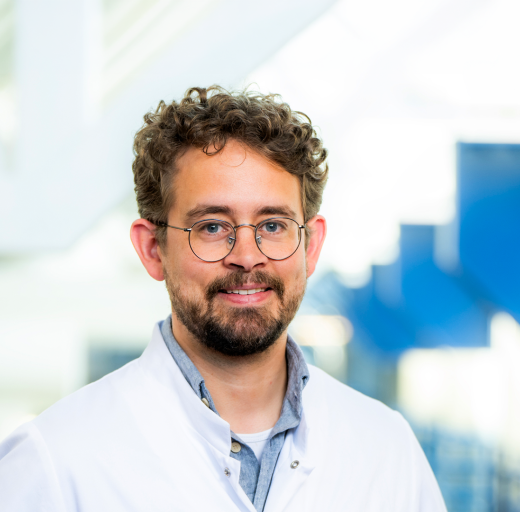
“Perhaps more people with Alpha-1 could benefit from infusion therapy.”
Infusion therapy
“There is not yet a good treatment for this disease, apart from the standard treatment for COPD,” says Tjeerd van der Veer. “It seems logical to replace the missing protein through an infusion. However, this does not always work, and it does not work for everyone. The amount of protein a person needs varies from one moment to the next. Normally, the body regulates this itself, but an infusion cannot properly mimic that process. Harmful clumps of the protein also remain in the body, which means people may continue to experience symptoms.”
Biomarker
In his research, Tjeerd van der Veer aims to predict which people with Alpha-1 will experience a decline in lung function later on. This is important because standard lung function tests only show damage once it has already occurred. “That is why I am investigating whether CT scans can provide earlier warning signs that the disease is worsening, such as thickening of the airway walls, mucus in the lungs, and changes in the blood vessels.” Such a CT scan could then serve as a biomarker: a measurement that provides information about how the disease is developing.
Better tailoring of care
“I use computer modelling to link the CT scan to the course of the disease,” explains Tjeerd van der Veer. “This allows us to see who remains stable and whose lung function declines. Care can then be tailored more effectively to the patient. Perhaps more people could then benefit from infusion therapy. This research gives people with Alpha-1 greater clarity about their future. That is especially important because, hopefully, a DNA-based treatment that can cure the disease will become available in the future.”
Research into rare lung diseases
Longfonds and the Swierenga Foundation are committed to advancing progress in the field of rare lung diseases. These are conditions that affect fewer than 1 in 2,000 people in the Netherlands. They are often diagnosed late or not recognised at all, and little funding is available for research. That is precisely why research into these diseases is important, but also challenging. The Longfonds-Swierenga Grant supports early-stage exploratory research in this field. Tjeerd van der Veer received €50,000 from the Longfonds-Swierenga Grant. This will enable him to further develop his innovative ideas, potentially opening the door to important breakthroughs in the future.